
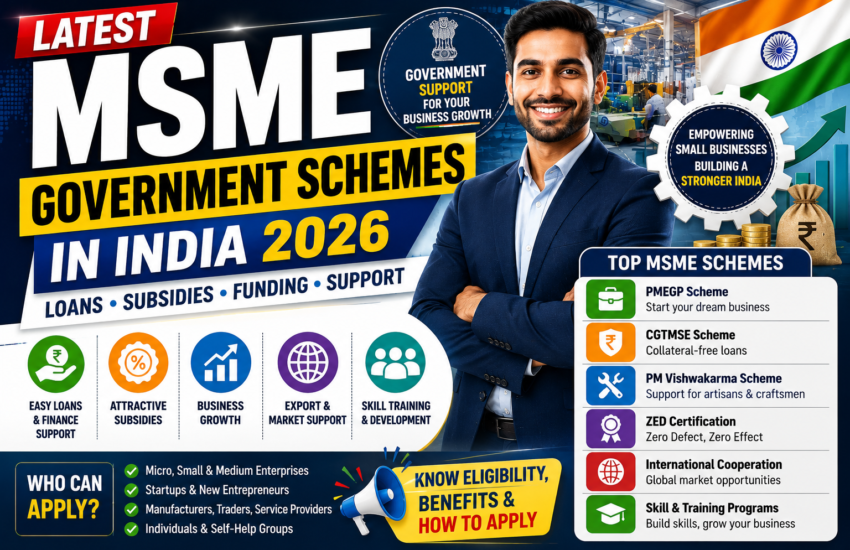
Micro, Small, and Medium Enterprises (MSMEs) are the backbone of the Indian economy. They generate millions of jobs, support exports, encourage innovation, and contribute significantly to India’s GDP.
However, small businesses often face challenges such as:
- Lack of funding
- Difficulty obtaining loans
- Outdated technology
- Limited marketing reach
- Export barriers
To solve these problems, the Government of India has launched several MSME schemes that provide financial assistance, subsidies, technology support, skill development, and export promotion.
This guide explains why these schemes were created, who created them, how they work, and how entrepreneurs can benefit from them.
What is an MSME?
As per the revised MSME classification effective from April 2025:
Micro Enterprise
- Investment up to ₹2.5 Crore
- Annual Turnover up to ₹10 Crore
Small Enterprise
- Investment up to ₹25 Crore
- Annual Turnover up to ₹100 Crore
Medium Enterprise
- Investment up to ₹125 Crore
- Annual Turnover up to ₹500 Crore
These classifications help determine eligibility for government support programs.
Why Did the Government Create MSME Schemes?
India realized that small businesses create more employment opportunities than large corporations.
However, many entrepreneurs struggle because:
- Banks demand collateral
- Technology is expensive
- Marketing budgets are limited
- Export procedures are complicated
To address these issues, the government introduced various MSME support schemes.
1. Prime Minister’s Employment Generation Programme (PMEGP)
Why Was PMEGP Created?
Many people have business ideas but lack capital to start.
The government introduced PMEGP to encourage self-employment and entrepreneurship.
Who Created It?
- Ministry of MSME
- Implemented through KVIC (Khadi and Village Industries Commission)
Main Objective
To help individuals start:
- Manufacturing businesses
- Service businesses
- Village industries
- Small enterprises
How Does It Work?
The entrepreneur receives:
- Bank loan support
- Government subsidy (Margin Money Assistance)
Impact
During FY 2021-22 to FY 2025-26:
- Over 4 lakh enterprises were established
- More than 36 lakh employment opportunities were created
Best For
- First-time entrepreneurs
- Rural businesses
- Manufacturing units
- Service providers
2. CGTMSE (Credit Guarantee Fund Trust for Micro & Small Enterprises)
Why Was CGTMSE Created?
One of the biggest problems for MSMEs was obtaining loans without collateral.
Most entrepreneurs don’t own large assets to pledge against loans.
Who Created It?
Established in 2000 by:
- Ministry of MSME
- SIDBI (Small Industries Development Bank of India)
Main Objective
To help businesses get loans without collateral security.
How Does It Work?
Instead of asking the entrepreneur for property security, the government provides a guarantee to the bank.
This reduces risk for lenders and improves access to finance.
Latest Update
As of April 2025:
- Credit guarantee support is available for loans up to ₹10 Crore.
- Women-led enterprises receive higher guarantee coverage.
Benefits
- Easier loan approval
- No collateral requirement
- Faster access to business funding
3. RBI MSME Lending Reforms 2026
Why Were These Changes Introduced?
Many small businesses still struggled to access financing.
To improve credit access, RBI updated MSME lending guidelines.
Major Changes
Earlier
Collateral-free loans:
₹10 Lakh
Now
Collateral-free loans:
₹20 Lakh
In some cases:
Banks may provide collateral-free loans up to ₹25 Lakh based on business performance.
Impact
- Easier financing
- Increased business expansion opportunities
- Better support for first-generation entrepreneurs
4. PM Vishwakarma Scheme
Why Was It Introduced?
Traditional workers often lack:
- Modern tools
- Financial support
- Skill development opportunities
Target Beneficiaries
- Tailors
- Carpenters
- Potters
- Goldsmiths
- Artisans
- Traditional craftsmen
Benefits
- Skill training
- Toolkits
- Financial assistance
- Market linkage support
Objective
To preserve traditional skills while improving productivity and income.
5. MSME Champions Scheme
Why Was It Created?
Indian MSMEs face strong competition from countries such as:
- China
- Vietnam
- Turkey
The government wanted Indian businesses to become globally competitive.
Main Focus Areas
- Lean Manufacturing
- Digital Transformation
- Design Improvement
- Intellectual Property Rights (IPR)
- Innovation
Goal
To modernize MSMEs and improve their national and global reach.
6. ZED Certification Scheme
What is ZED?
ZED stands for:
Zero Defect, Zero Effect
Meaning:
- Zero product defects
- Minimal environmental impact
Why Was It Created?
International buyers increasingly demand:
- High quality products
- Sustainable manufacturing
- Environmental responsibility
Benefits
Certification Support
- Bronze Certification
- Silver Certification
- Gold Certification
Additional Assistance
- Testing and certification subsidies
- Technology upgradation support
- Consultancy assistance
Export Benefits
ZED-certified businesses often gain greater trust among international buyers.
7. MSME Lean Manufacturing Scheme
Why Was It Created?
Many factories experience:
- High waste
- Low productivity
- Higher production costs
Solution
The government promotes Lean Manufacturing techniques.
Benefits
- Cost reduction
- Better efficiency
- Improved profitability
- Faster production
Government Support
The scheme subsidizes a major portion of implementation costs.
8. MSME Innovative Scheme
Why Was It Created?
Innovation drives business growth.
The government wants Indian MSMEs to:
- Create new products
- Develop intellectual property
- Adopt technology
Components
Incubation
Support for business ideas and startups.
Design
Support for product design improvement.
IPR
Patent and trademark support.
Financial Assistance
- Up to ₹15 Lakh for innovative ideas
- Up to ₹1 Crore for incubation infrastructure
- Patent reimbursement support
9. Procurement & Marketing Support (PMS) Scheme
Why Was It Created?
Many MSMEs produce quality products but struggle to find customers.
Benefits
Government helps businesses participate in:
- Trade fairs
- Exhibitions
- Buyer-seller meets
- Marketing events
Goal
Increase visibility and sales opportunities.
10. International Cooperation Scheme
Why Was It Created?
Many Indian businesses want to export but lack international exposure.
Benefits
Support for:
- International exhibitions
- Trade missions
- Global buyer meetings
- Export promotion activities
Ideal For
- Exporters
- Manufacturers
- International traders
SIDBI Growth Initiatives 2026
The Government continues strengthening MSME financing through SIDBI.
Recent initiatives include:
- Enhanced MSME financing programs
- Emergency credit support
- Additional funding capacity
These measures help businesses access capital more easily and expand operations.
How MSME Schemes Help Different Businesses
Manufacturing
- Machinery funding
- Technology upgrades
- Export support
Textiles
- Export assistance
- Marketing support
- Skill development
Technology Startups
- Innovation funding
- Incubation support
- Patent assistance
Traditional Businesses
- Toolkits
- Training
- Financial support
Future of MSMEs in India
The government aims to make India:
- A global manufacturing hub
- A leading export economy
- A technology-driven business ecosystem
Future focus areas include:
- AI adoption
- Automation
- Digital transformation
- Global exports
- Startup growth
MSMEs will play a critical role in achieving these goals.
Conclusion
MSME schemes are not just subsidy programs; they are part of India’s long-term economic development strategy.
The government’s objectives include:
- Creating jobs
- Encouraging entrepreneurship
- Increasing exports
- Improving manufacturing
- Supporting innovation
- Making Indian businesses globally competitive
Entrepreneurs who understand and utilize these schemes can gain significant advantages in funding, technology, marketing, and business growth.
